Custom manufacturing
Inventory, costing and margin software for custom manufacturers
Built for a custom wagon manufacturer in the United States, making made-to-order vehicles across three factories with subcontracted work in the mix.
Made-to-order manufacturing has a particular problem: the quote goes out before anyone knows what the thing costs. This portal exists to close that gap, so the margin is visible while the price is still changeable.
- Sector
- Custom manufacturing
- Stack
- Vue · .NET Core
- Role
- Full stack developer
The problem
What made-to-order manufacturing gets wrong
The margin is known too late
A price is quoted from experience, and the true cost only assembles itself after the build is finished and the invoices have landed. By then the job is either profitable or it is not.
The costs live in four places
Material in one system, labour on timesheets, overhead in an accountant’s spreadsheet, shipping on an invoice. Nobody adds them up per job until year end.
Shortages surface on the shop floor
A build stops because a part is not there, and the purchasing decision that would have prevented it was never connected to the project that needed it.
Three factories, three versions of the truth
Each site keeps its own stock figures and its own build list, so capacity and material cannot be looked at across the business.
Invoices drift away from builds
Payments received and actual shipping cost sit in the finance system, disconnected from the build they belong to, so per-project profitability stays theoretical.
Subcontractor pricing and commission are spreadsheet work
Every product has a build cost, a subcontractor price and a commission rate, and working out the effect of changing one is a manual exercise.
The answer
How the portal handles it
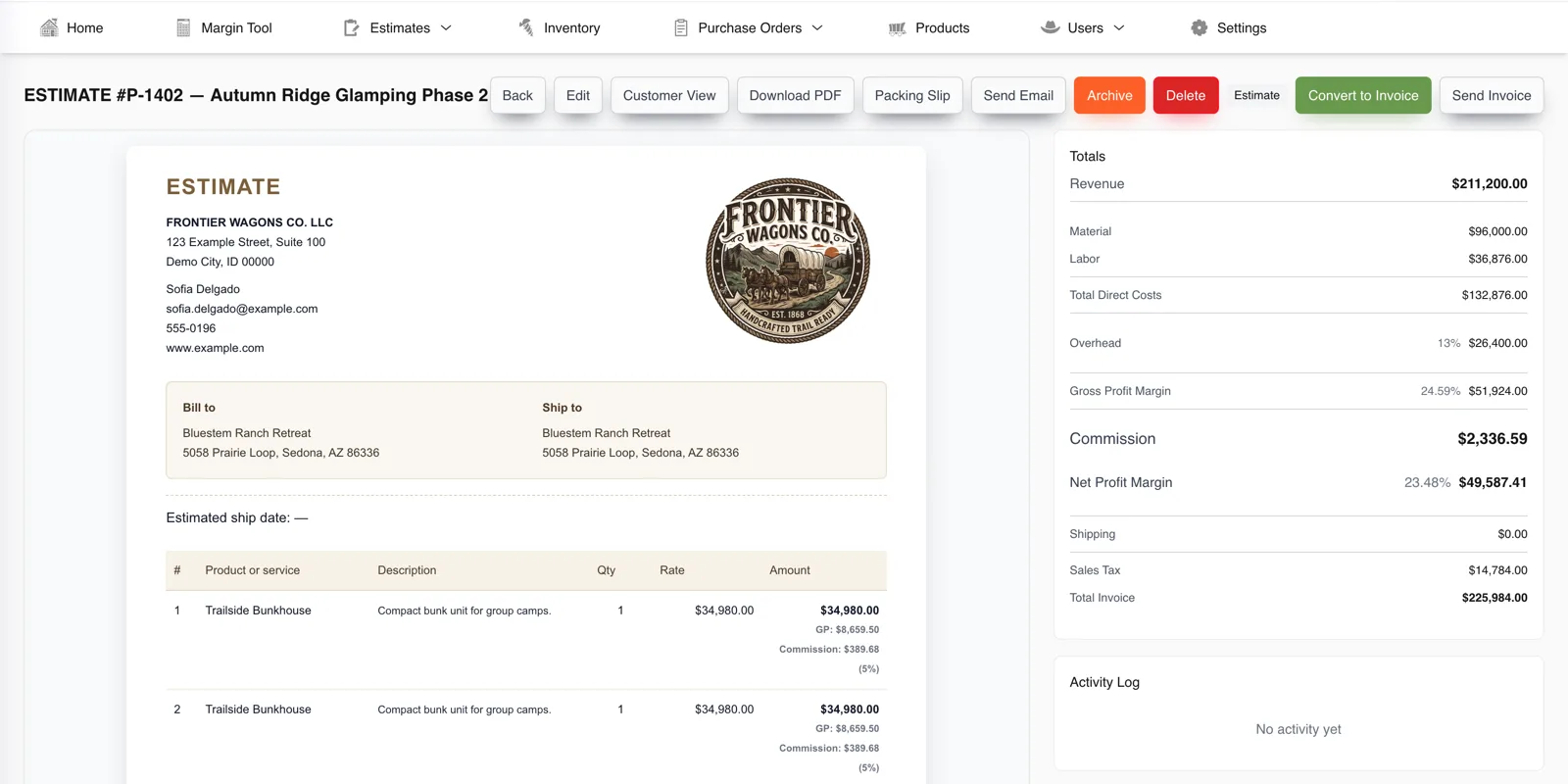
An estimate breaks revenue into material, labour and overhead and returns a gross and a net margin on the spot. The quote can be adjusted against a real number rather than a feeling, before it is sent.
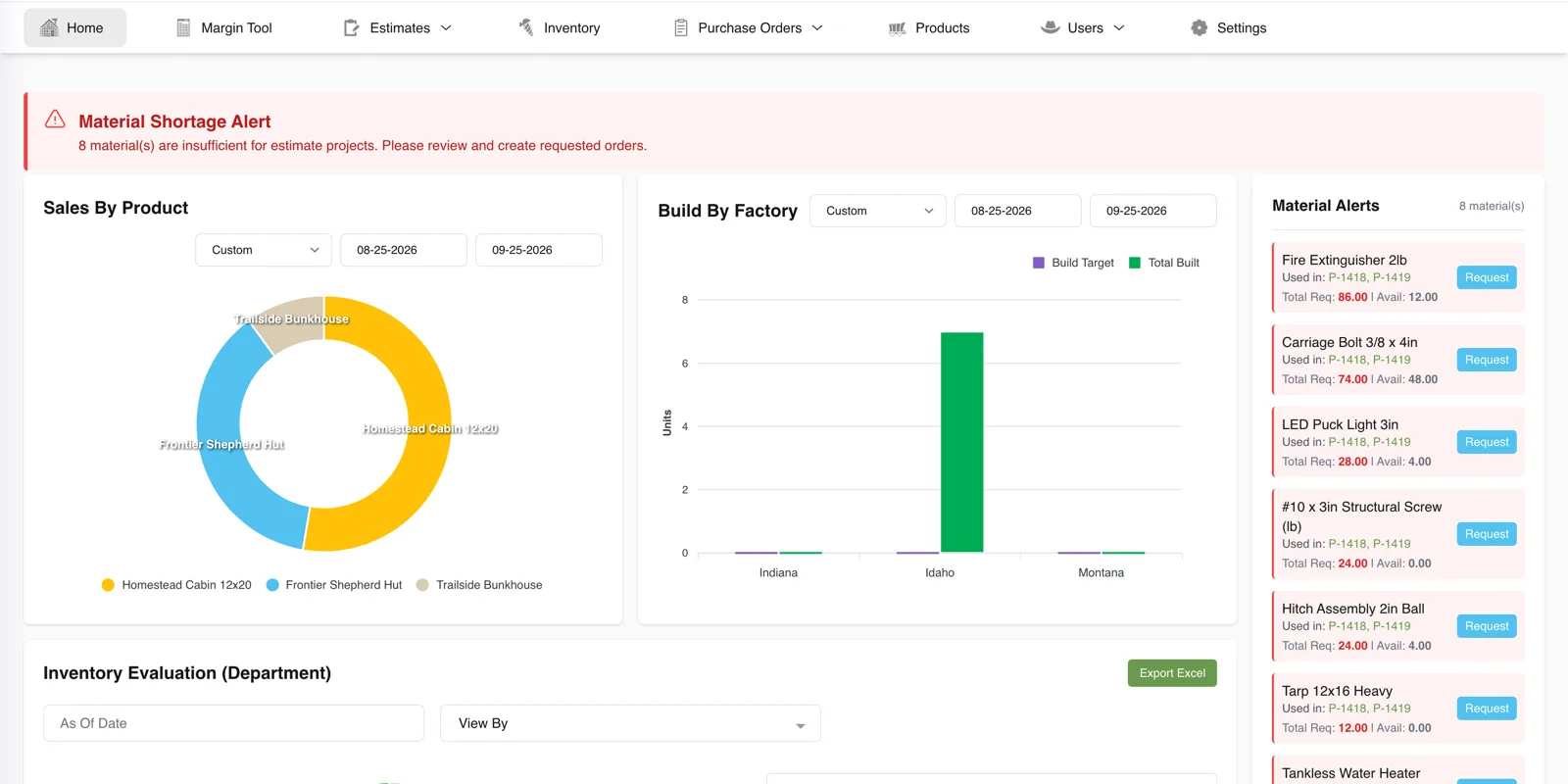
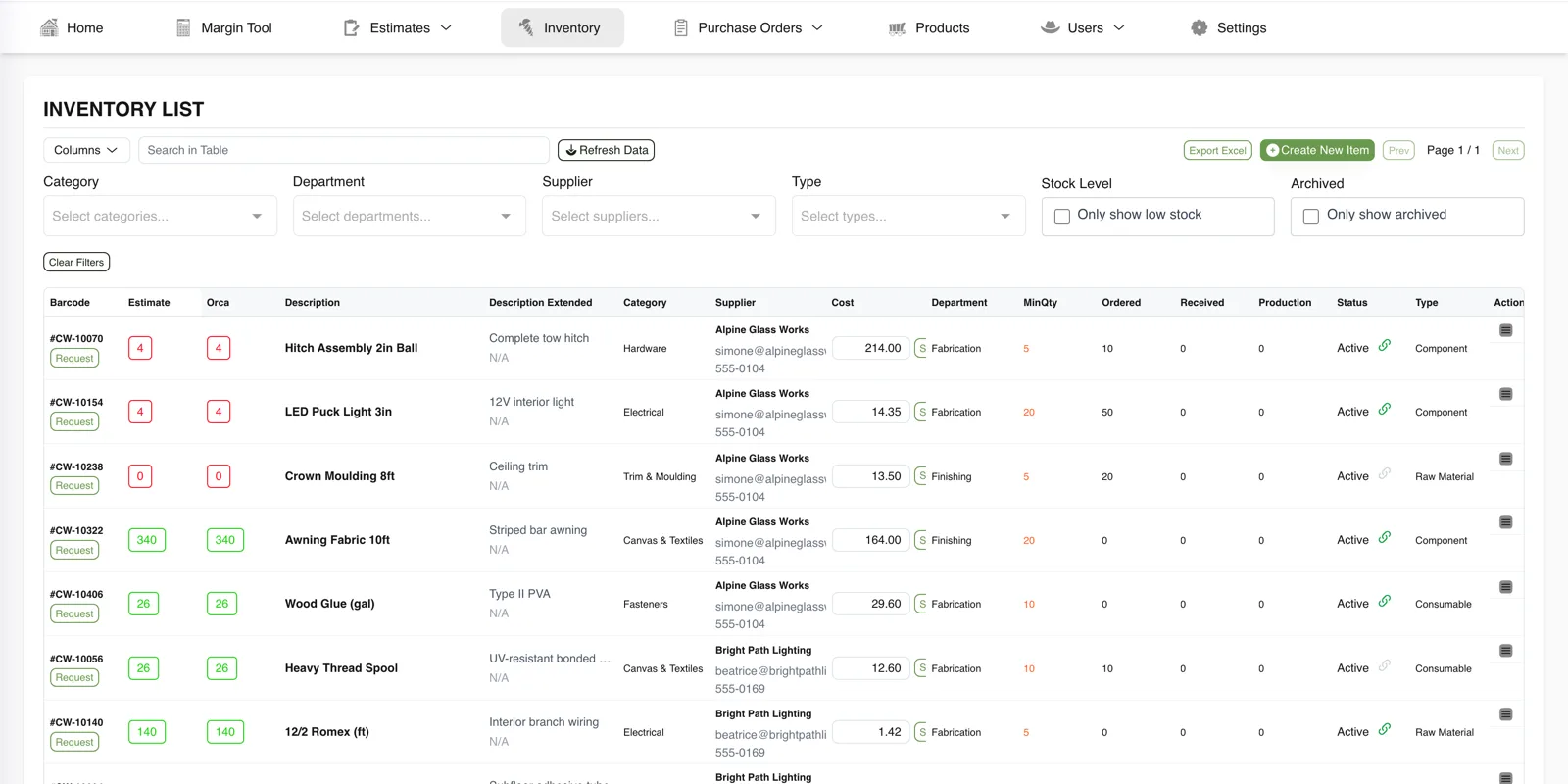
Inventory carries barcode stock levels, suppliers and unit costs, with low-stock filters. When stock runs short the system raises an alert against the projects that need that material — the alert becomes a requested order, and the requested order becomes a purchase order, so purchasing is driven by the build schedule rather than by whoever noticed.
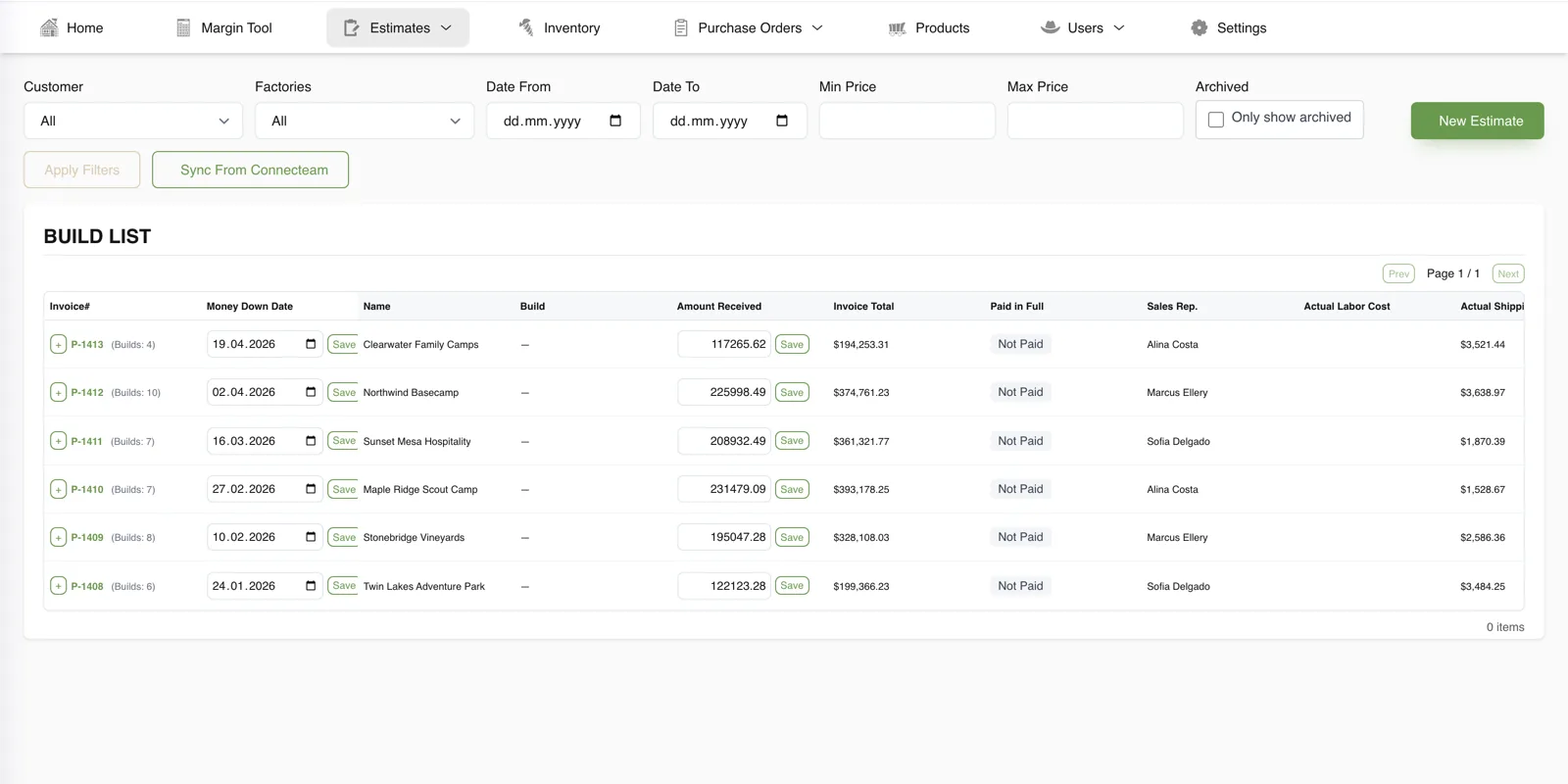
The build list tracks invoices raised, payments received, and actual labour and shipping cost per project, so estimated margin and realised margin sit next to each other.
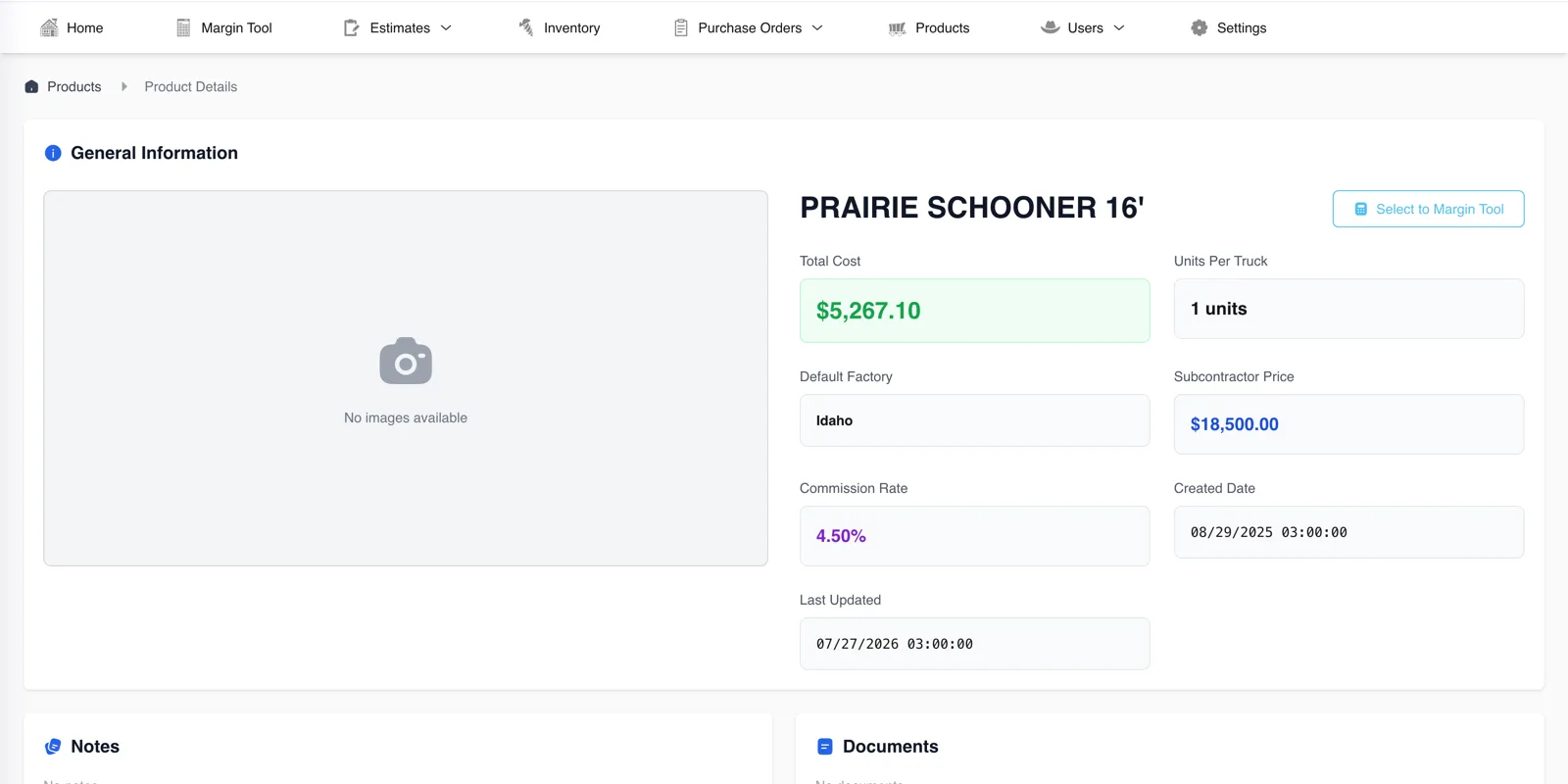
Each product record holds its total build cost, subcontractor price, commission rate and factory assignment, and the dashboard reports sales by product and build targets by factory across all three sites at once.
Screens
What it looks like in use.
Features
What is in it
- Estimates splitting revenue into material, labour and overhead
- Live gross and net margin per estimate, before the quote is sent
- Inventory with barcode stock levels, suppliers, unit costs and low-stock filters
- Material shortage alerts raised against the projects that need the stock
- Shortage → requested order → purchase order, as one chain
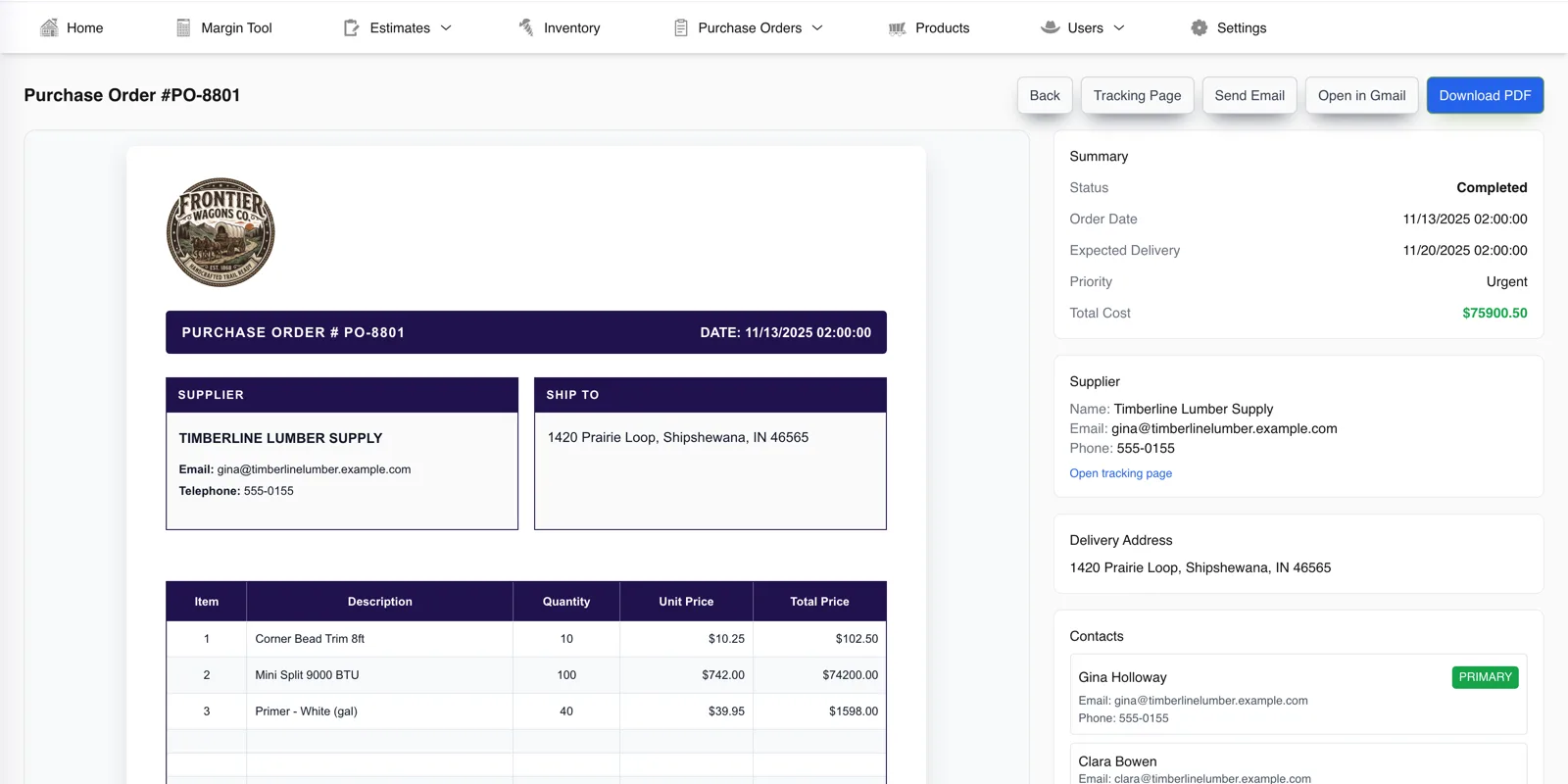
- Purchase orders with supplier, line items, totals and delivery tracking
- Build list with invoices, payments received and actual labour and shipping cost
- Product records with build cost, subcontractor price, commission rate and factory
- Dashboard of sales by product and build targets by factory
- Three factories reported together or separately
Under it
How it is built
The integrations are the point rather than a bonus. OrcaScan handles barcode capture on the floor, QuickBooks and Bill.com keep the finance side where the accountants already work, Connecteam covers the crew, and Twilio and Gmail carry the notifications. The portal is the layer that makes those tools agree about a job.
Questions
The things people ask first.
Does this only work for vehicle manufacturing?
No. It suits any made-to-order manufacturer that quotes before it builds — trailers, modular buildings, furniture, machinery, fit-out. The requirement is that a job has a bill of materials and a labour estimate.
Can it handle more than one site?
It was built for three factories, with build targets and stock tracked per site and reported together.
Does it replace our accounting software?
No. It integrates with QuickBooks and Bill.com rather than duplicating them. The portal owns the build and the cost of it; the accounts stay where your accountant expects them.
How do the shortage alerts work?
Stock levels are checked against what committed projects need. A shortage raises an alert against those projects, which becomes a requested order and then a purchase order, so the reason for the order stays attached to it.
If you quote made-to-order work and only find out the margin afterwards, that is a solvable problem and usually the highest-value one to solve. I am at cuneyt.irmak@outlook.com.
More work
Other systems I have built.
- TradeSorterBarcode stock control and purchase orders for hardware stores and builders’ merchants.
- Audit Tracking PortalSafety and quality audits, corrective actions and target tracking for field teams.
- Event & Team Management PortalWeek-by-week crew planning with hotels, vehicles and invoice status per event.
- Scientific Instrument Project Management PortalLab job intake, quoting and approval for in-house machine shops.
- Schedule Planner PortalWeekly rotas across sites, typed by session, with activity counts for funders.